The quest for a sustainable workshop on sustainability at Green Software Brighton
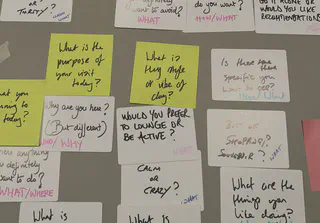 A typical workshop which might include sticky notes and playing cards
Runway East, Brighton
A lightning talk where I reflected on digital sustainability and the irony that workshops designed to unlock our thinking tend to consume vast amounts of single use and non-recyclable materials. I asked the question, “how we can truly envision the future when we keep using the same old tools?”.
You can access the Figma slides for this short talk via this link.

Short talk, long thinking
As is often the case with my talks, although the talk was short and thankfully kept to time, the thinking was long and deep.
My thinking for this talk was heavily influenced by attending the Futures Through Design short course at the Royal College of Art in July 2025. During the course, I learned about signals, horizon scanning, and facilitating workshops to help envision regenerative futures. Such ‘futures’ may be beyond our usual ‘workshop’ thinking, which can be encumbered by structural barriers, financial limitations, and to a certain extent fear of the unknown.
I cannot fault the delivery of the course, which was incredible, thoughtful, and thoroughly researched. However, attending uncovered some ethical questions for me about the position and priviledge of designers who have financial and socio-political power to envision the ‘future’ and tell the stories of the future. A future which they may or may not be part of based on recent shifts in the tech sector and a future that still reflects the troubling power dynamics we see today.
This uneasy feeling was further heightened after attending an amazing talk by Dr Dan Hicks about his book, Every Monument Will Fall - A Story of Remembering and Forgetting (Penguin/Hutchinson Heineman). I got to chat with Dan after his talk, and it was one of the best disucssions of my life. Needless to say, as an amateur art historian, this book is very much on my to-read list.
So, on a meta level, personally I was troubled by aspects of what is sometimes called ‘speculative design’ or ‘futures’. In these situations, were we as designers colonising the future? Would it be best to reimagine power first before reimaging action, or output? Or do we need to uncover tangible future objects as power is fleeting, too difficult, or perhaps too downright depressing? I couldn’t shake the feeling that we ‘futurists’ are rogue archaeologists and like the archaeologists of yore we engineered meaning based on limited understanding, empathy, and exploration of the descendent cultures near the ‘dig site’. At a micro level I also observed how many single use paper products it took us to explore these ideas. These dilemmas are my own and I continue to explore my thoughts through my design and art practices.
So this talk set out a series of commitments, which I then beta tested during the Green Software Practitioner Study Day in August 2025. I then successfully reused resources I created (mini-whiteboard cards) at work-related workshops in October 2025. However, there is a level of irony that when running a full on ‘futures’ workshop for the first time in December, I used more paper than ever! This was due to the scale of the event and unknown Wi-Fi connectivity. So, it is all a ‘work-in-progress’.
What I will say is the December event with the ‘futures’ workshop took an approach, informed by Dr Sayani Mitra’s Talk UX presentation and Rob Hopkins’ books. Exploring 5 years into the future, we created imaginary artefacts, but very much through the lens of our issues today and this felt like an inclusive, effective, yet non-invasive approach to ‘Futures’. As is often the case, I need time and practice to figure things out of my own and draw upon a range of influences and inspirations.
I end by posing a question:
What if the things that we need for the future need to be both remembered and imagined?

An example of this was these fantastic fish traps from the UK about 200 years ago which I saw at the More than Human exhibit at the Design Museum in August 2025 (from the Pitt Rivers Museum collection). These beautifully crafted objects were designed to catch only mature fish, letting young fish go free to minimise harm to fish populations.
We knew how to live with and design for our environment, but we have willfully forgotten.
